Why Founding a Startup Was the Worst Best Decision of My Life
December 04, 2025
December 04, 2025
It has been three years since the world changed. If you read the history books—or just scroll Twitter long enough—November 30, 2022, is the singularity. It is the day OpenAI released ChatGPT, the day the tectonic plates of technology shifted, rendering millions of business models obsolete and birthing a trillion-dollar industry.
But if you look at my calendar, the date that matters is November 27, 2022. Three days before Sam Altman changed the world, I launched Writee AI. We had spent months agonizing over the roadmap. We had built a "distraction-free writing assistant." We had an MVP. We had a strategy. We had the arrogance of students in a dorm room who thought they knew what the market needed. And for exactly 72 hours, we felt like gods.
Then, the universe played its hand. I remember testing ChatGPT that week. The sensation wasn’t fear—it was something colder. It was the nausea of total obsolescence. We had built a faster horse three days before Ford rolled out the Model T.
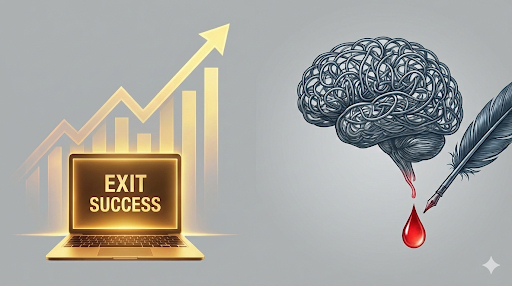
On LinkedIn, I frame this as a story of resilience. I talk about how we pivoted, how we scraped together an acquisition, how we exited. It’s a hero’s journey. It fits the narrative of the "successful founder."
But here, I can tell you the truth: That week didn’t just build character. It broke something in me. It was the moment I learned that "effort" is not a variable in the equation of success. You can bleed for a year, and the market can delete you in a second.
That was the start of the "worst decision." Not because we failed—we didn't—but because I learned to live with a gun to my head. And the terrifying part is, I started to like it.
There is a specific metaphor I return to when juniors or MBA aspirants ask me about founding a company. They expect me to say it’s like "building a plane while falling" or some other sanitized Silicon Valley cliché.
No. It’s like tasting blood.
Before Writee, I was a student at Jadavpur University. I was ambitious, sure, but my ambition was theoretical. It was academic. It was safe.
Building the startup changed the chemistry of my brain. When you are a founder, the barrier between "you" and "the work" dissolves. If the server crashes, you crash. If a user churns, it isn't a metric; it is a personal rejection. You don’t sleep because sleep feels like negligence.
We talk about the "hustle" as if it’s a badge of honor. We post photos of late-night coding sessions. But we don’t talk about the physiological cost. We don't talk about the cortisol spikes that become your baseline. We don't talk about the gray hairs at 22.
I remember looking at my friends who were taking the standard path—preparing for placements, aiming for Day 0 offers, going on dates, sleeping eight hours. I looked at them with a mix of envy and contempt.
Envy, because they were at peace. They had weekends. They had "off" switches. Contempt, because they were asleep. I felt alive in a way they didn’t. I was hunting. I was surviving. But that vitality came at a price: I lost the ability to be still. I lost the ability to be content with "enough."
And once you taste that level of agency—the ability to move a metric with your bare hands—you become feral. You can’t go back to the zoo.
And yet, I tried to go back to the zoo.
After the exit, after the chaos, I went to Bain & Company.
On paper, this was the dream. The validation. The "finishing school" for the business elite. I was an IIM Calcutta alum, an exited founder, now a strategy consultant at an MBB firm. I had "won" the career game.
But the timeline matters. If I had done Bain before the startup, I would have loved it. I would have marveled at the frameworks, the polish, the intellectual rigor. I would have fit in.
But I did it after.
And that made all the difference.
Walking into the corporate world after being a founder felt like walking into a library after being in a trench war. Everything was so… quiet. So structured. So undeniably safe.
I remember sitting in meetings discussing slide formatting. We would spend forty minutes debating the shade of green on a bar chart or the precise wording of a title. My colleagues - brilliant, hardworking people - were stressed about these details. They were genuinely anxious about the Partner’s feedback on the deck. And I sat there, dissociated.
My brain was still wired for survival. I was used to waking up wondering if we had enough runway to pay the interns. I was used to wondering if an API change by a third-party provider would kill our entire product.
So when faced with a "crisis" about a PowerPoint slide, I couldn't feel it. The stakes felt artificial. “The model is broken,” someone would say. In my head, I’d think: No, the Excel formula is broken. You fix it in 30 seconds. When I said ‘the model is broken’ last year, it meant we had no business viability.
I realized then that I had ruined myself. The startup had stripped away my patience for the performative aspects of work. I couldn't appreciate the "process" anymore; I only cared about the outcome.
Bain is an incredible machine. It teaches you how to think. But it operates on the assumption that the world is logical, that problems can be solved with enough data and a 2x2 matrix.
My startup experience had taught me that the world is chaotic, unfair, and driven by timing and luck. No amount of slides can stop a November 30th from happening.
I felt like an alien. I was a feral cat trying to act like a house pet, pretending to care about the brand of kibble when I was used to hunting mice.
This is the tragedy of the "Best Decision." Founding Writee gave me confidence. It gave me a financial cushion. It gave me a network. It gave me the identity of a "Founder."
But it took away my peace.
I see it in how I approach everything now. I can’t watch a movie without analyzing the production unit economics. I can’t use an app without criticizing the UX flow. I can’t look at a problem without immediately trying to monetize the solution.
I have spoken to other founders who have exited, and we share a secret, dark look. It’s the look of addicts.
We complain about the stress. We complain about the 80-hour weeks. We swear that next time, we’ll get a "normal job." We’ll work 9-to-5. We’ll take up pottery. We’ll just... exist. But we’re lying.
We can’t do it. The moment the silence sets in, the moment the safety of a regular paycheck hits the bank account, the itch returns. The silence is too loud.
We need the chaos. We need the feedback loop. We need the impossible odds.
I look at my short stint at Bain - the stability, the clear career path, the prestige - and I know I walked away from a "good life." A life of weekends and predictable vacations. A life where your self-worth isn't tied to your Monthly Recurring Revenue.
But I realized that once you have driven the car at 200mph, driving at 60mph doesn't feel like safety. It feels like you’re parked.
So, here we are. Two versions of the same story. On LinkedIn, the story of Writee AI is a triumph. It is the story of a young man who saw an opportunity, built a product, navigated a market collapse, and emerged victorious. It is a story of Strategy.
On this blog, it is a story of a loss. It is the story of a young man who traded his ability to be content for a shot at glory, and who now finds himself permanently restless, unable to fit into the structures of the normal world. It is a story of
Psychology. Both are true.
The LinkedIn version gets me the meetings. It gets me the credibility. But the blog version is the one that keeps me up at night. I sometimes wonder, if I could go back to November 2022, knowing what I know now - knowing the stress, the rewiring, the alienation from the corporate path - would I do it again?
The rational answer, the "Bain Consultant" answer, is No. The ROI on peace of mind is too high to sacrifice. The risk-adjusted returns are negative.
But the "Founder" in me? The one who tasted blood?
He knows the answer is Yes.
And that terrifies me.