Open Source in Business - Concept Note

July 30, 2025
Not every good idea is worth building. A personal reflection on startup decisions, sales challenges, and founder-market fit.

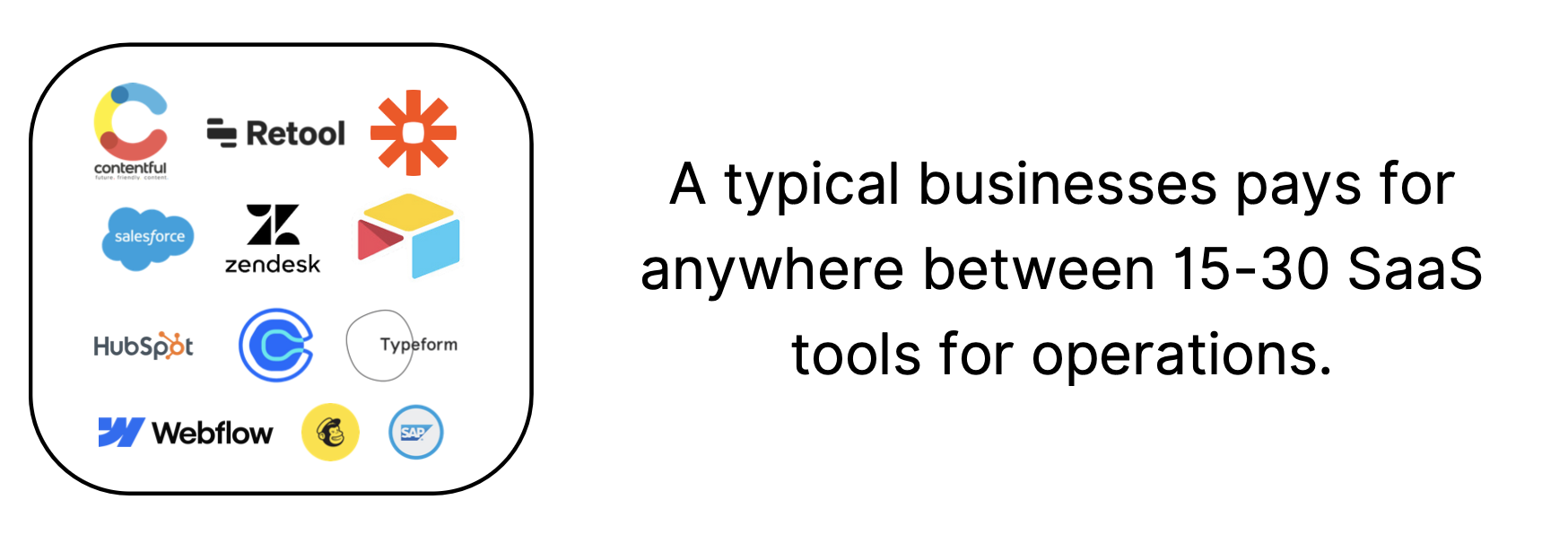
In this digital world, businesses rely on a host of different SaaS tools and services to run their operations from simple tools like Calendly and AirTable to complex tools such as HubSpot and Freshworks. The costs keep adding up as the businesses scale and there comes a point where these tools start eating into the revenue of the companies. A very good alternative to this is to use Open Source Software that is self-hosted. This reduces cost for a early stage company using a few tools by half and for a later stage company using tools at scale by 1/10th.

The SaaS tools are more often than not used by business users and they are more often than not unaware of the availability of open source alternatives. For those that are aware of them are shied away by the complexities that come in with managing these open source services for the companies. The business users do not want to divert their tech talent from building their core offerings to maintaining and managing OSS scaling and operations.

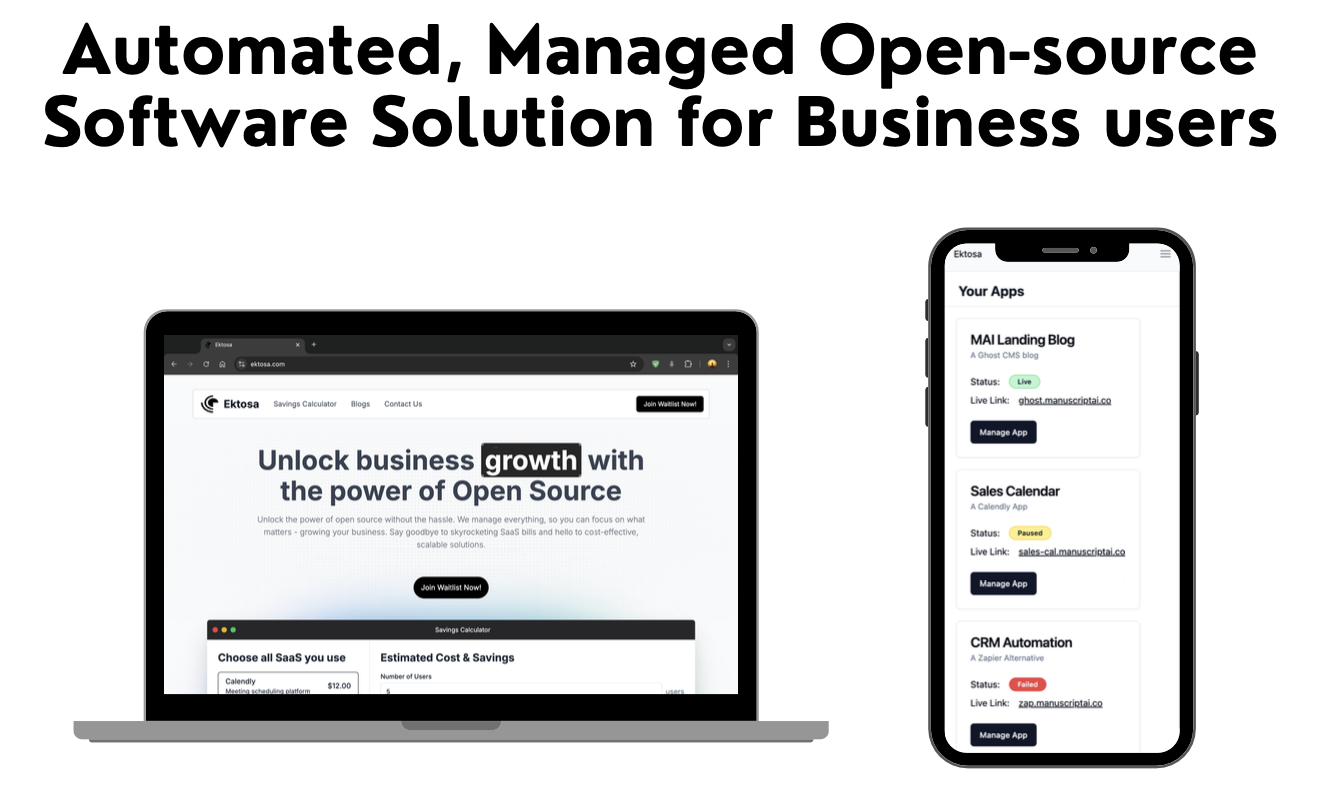
Our company is poised to disrupt the software industry by offering a revolutionary platform that provides managed open-source software (OSS) alternatives to expensive SaaS solutions. We aim to bridge the gap between cost-effective OSS and the ease of use that businesses expect from SaaS products allowing companies to significantly reduce their software costs while maintaining functionality.

Key points:

  • Significant cost savings for businesses of all sizes
  • Managed service eliminating technical complexities for users
  • Targeting the underserved market of non-technical business users
  • Potential to reshape the software industry landscape

Problem Statement

As businesses grow, they increasingly rely on multiple SaaS tools for their operations. This leads to escalating costs that can significantly impact a company's revenue. While open-source alternatives exist, many business users are unaware of them or are deterred by the technical challenges of implementation and management. The proliferation of SaaS tools in modern businesses has led to several challenges:
  1. Escalating Costs: As companies grow, they adopt more SaaS tools, leading to ballooning expenses that can significantly impact profitability.
  2. Lack of Awareness: Many business users are unaware of open-source alternatives to popular SaaS tools.
  3. Technical Barriers: Even when aware, businesses often lack the technical expertise to implement and manage OSS solutions effectively.
  4. Resource Allocation: Companies are reluctant to divert their technical talent from core business functions to manage OSS infrastructure.
  5. Scaling Challenges: As businesses grow, the cost of SaaS tools increases disproportionately, often outpacing the company's growth rate.

Solution Overview

We are developing a one-stop platform that enables business users to easily adopt and use open-source software as an alternative to expensive SaaS tools. Our comprehensive platform provides the following features:
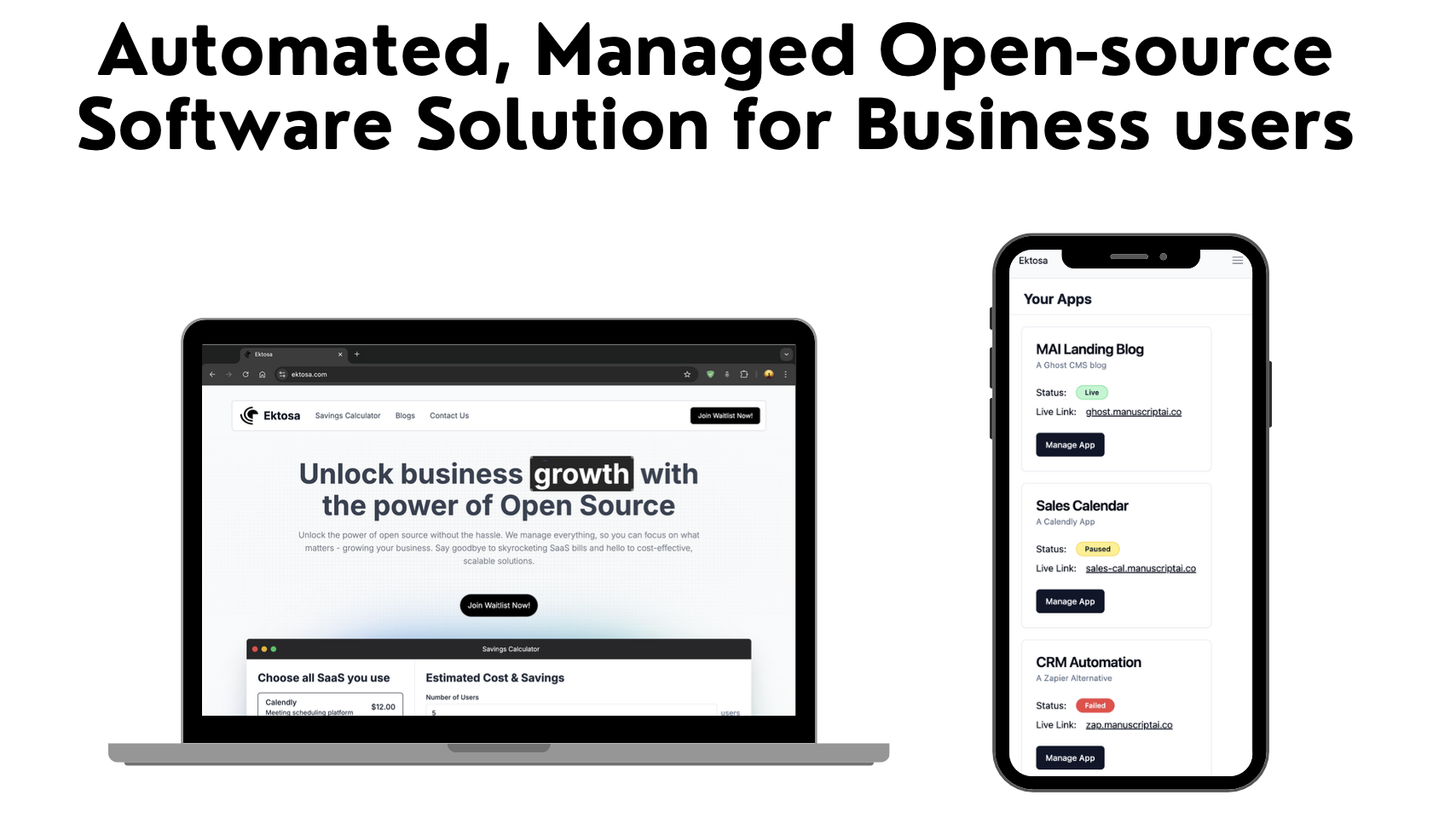
  1. User-Friendly Interface: Our platform features an intuitive GUI allowing non-technical users to select and implement OSS tools easily.
  2. Previews of Each OSS App: Fully featured previews of every open-source apps, with a detailed lists of features, pros and cons to satisfy your every query.
  3. Managed Backend: We handle all technical aspects of hosting, managing, and scaling the OSS, including:
    • Server provisioning and maintenance
    • Software installation and updates
    • Security management
    • Performance optimization
    • Backup and disaster recovery
  4. Migration Services: We offer seamless migration from existing SaaS products to OSS alternatives, minimizing disruption to business operations.
  5. Scalability: Our infrastructure is designed to grow with our clients, ensuring consistent performance as their needs evolve.

Target Market

Our primary target markets are:

  • Early-stage companies (Seed/Series A) in the US and India
  • Mid to late-stage companies looking to optimize their software costs

Value Proposition

We offer a unique value proposition to our target market:

  1. Substantial Cost Savings:
    • Early-stage companies: Up to 50% reduction in software costs
    • Later-stage companies: Up to 90% reduction in software costs at scale
  2. Simplified Adoption:
    • User-friendly interface designed for non-technical business users
    • Eliminates the need for in-house expertise in OSS implementation and management
  3. Comprehensive Managed Service:
    • Handles all technical complexities, including hosting, scaling, and maintenance
    • Allows companies to focus on their core business functions
    • Provides enterprise-grade security and reliability
  4. Scalability:
    • Cost-effective scaling as the company grows
    • Eliminates the steep price increases typically associated with SaaS user count increases
  5. Customization and Integration:
    • Seamless integration with existing systems and workflows

Business Model

We will charge a monthly service fee based on the number of apps hosted and the scale of operations:

  1. Early-stage companies:
    • $50/month for up to 5 apps
    • $100/month for up to 10 apps
    • Additional apps priced at $10/month each
  2. Later-stage companies:
    • Base price of $500/month for up to 10 apps
    • Additional pricing based on usage metrics (e.g., user count, data volume, API calls)
    • Estimated average of $1600/month per company

Competitive Landscape

While there are players in the OSS hosting space, our unique positioning sets us apart:

Existing Competitors:
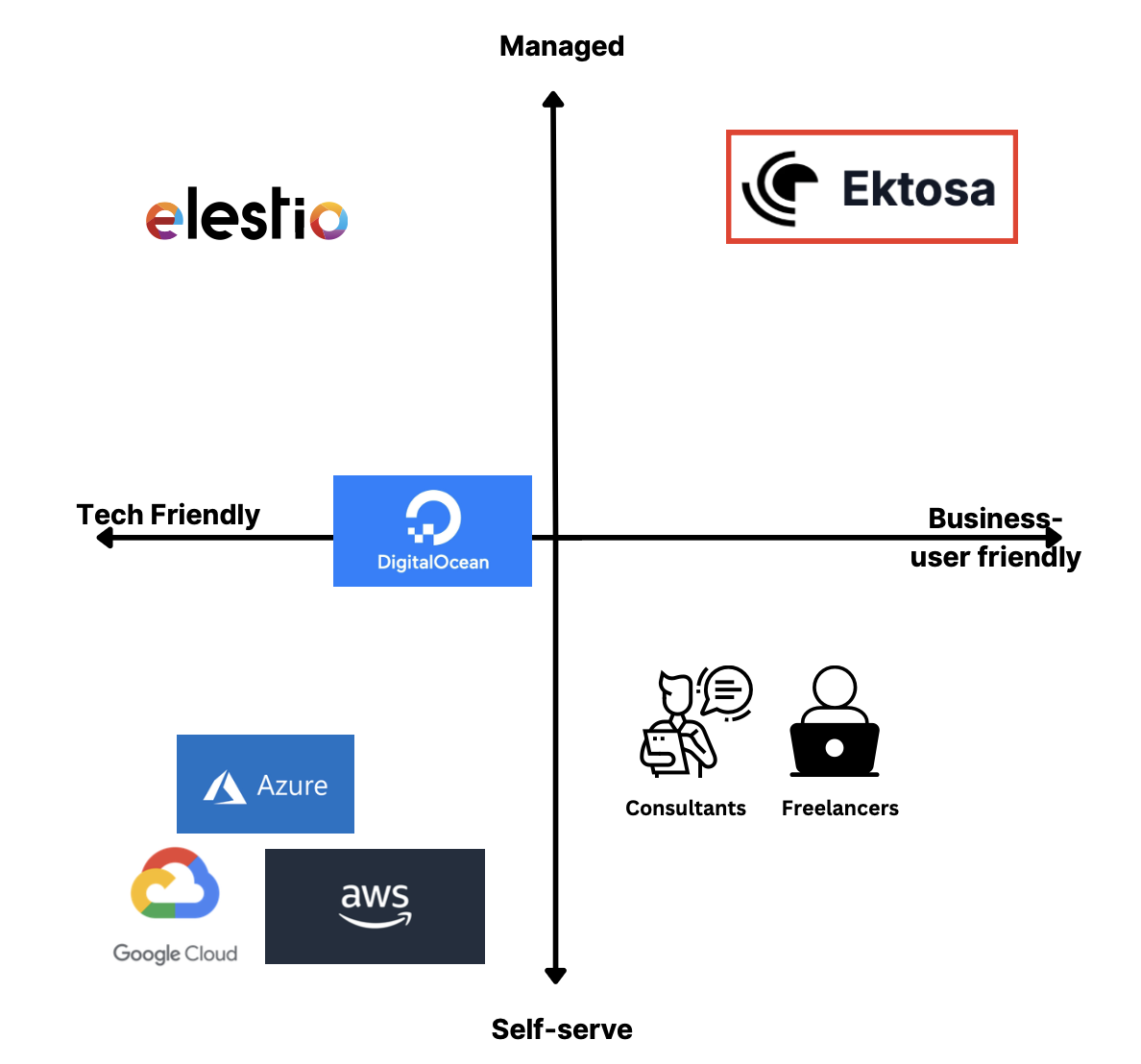
  • Smaller players: Elestio, Centron, Nexcess (focused on technical users)
  • Major hosting providers: AWS, Digital Ocean (offer related services but not tailored for non-technical users)

Our Competitive Advantage:

  • Focus on non-technical business users
  • Comprehensive education and migration support
  • Simplified user interface for complex OSS tools
  • Integrated platform for multiple OSS alternatives

Potential Future Competition:

  • SaaS providers may introduce lower-cost tiers or open-source versions
  • New entrants may emerge as the market for OSS alternatives grows

Market Size

Based on the number of Seed/Series A companies in the US and India, we estimate:

  • Serviceable Addressable Market: 196,000 companies
  • Assuming 10% market share: 20,000 companies
  • Potential ARR in 5-7 years: $106.32M (Early-stage: $18M, Later-stage: $88.32M)

Challenges & Risks

  1. Market Education:
    • Overcoming lack of awareness about OSS alternatives
    • Building trust in OSS reliability and security
  2. Technical Complexity:
    • Managing multiple OSS solutions at scale
    • Ensuring consistent performance and reliability across diverse software
  3. Competition:
    • Potential resistance and countermeasures from established SaaS providers
    • New entrants as the market opportunity becomes apparent
  4. Operational Scalability:
    • Rapidly scaling our own infrastructure to meet growing demand
    • Maintaining service quality while expanding the portfolio of supported OSS tools

Why I didn’t pursue this?

In isolation, the idea made sense. The problem was real, the economics were compelling, and the market was large enough to justify the effort.

But over time, I realised something more important: not all good ideas are good for you.

The biggest challenge was customer acquisition. More often than not, people don’t buy the promise of being cheaper, they buy the promise of trust. And in this case, I wasn’t just asking companies to switch tools; I was asking them to rethink the very foundation of how they run their operations - That’s a hard sell.

You can’t just walk into a conversation and say, “Hey, I’ll save you a lot of money.” Many companies are perfectly fine paying that premium if it buys them reliability, familiarity, and peace of mind. Which means this isn’t a pricing problem - it’s a trust problem. And trust takes time, repetition, and strong distribution to build.

I also had to be honest with myself: I’m not the strongest enterprise salesperson. This business would have required exactly that—long sales cycles, multiple stakeholders, and a lot of uphill convincing. It was a game of persistence and persuasion, and I wasn’t sure that was the game I wanted to play.

There was also a deeper realisation. This was a business that required patience before insight. It depended on educating a market that didn’t yet know it had a problem, building heavy operational infrastructure, and pushing gratification far into the future.

And I’ve come to understand that I don’t operate well in slow games. I prefer ideas where feedback is immediate, where distribution can be tested quickly, where you know within weeks - not years - whether you’re onto something. This, despite its potential, felt like a long, uncertain climb.

So I didn’t pursue it. Not because it wouldn’t work, but because I didn’t believe I was the right person to make it work now. And increasingly, that’s become my filter: Not “Is this a good idea?” but “Is this a game I want to play?”

Sign-up to my newsletter

I talk about start-up, investing, tech and everything around it. Sign-Up for my weekly newsletter to never miss an update